- 3
- 8
- 3
- 4

- No.62, Melagama, Wadduwa, Sri Lanka 12560
- 24 x 7
Polonnaruwa, situated in Sri Lanka’s North Central Province, is one of the country’s most fascinating ancient cities and a UNESCO World Heritage Site. Serving as the second capital of Sri Lanka after the fall of Anuradhapura, Polonnaruwa flourished during the 11th to 13th centuries CE. It became the center of Sinhalese culture, Buddhist learning, and impressive architectural and engineering advancements.
The city’s well-preserved ruins offer a window into the golden era of Sri Lankan civilization, characterized by religious tolerance, technological innovation, and grand artistic expression. Polonnaruwa is not only a monumental historical site but also a source of national pride, cultural identity, and spiritual reverence.
The history of Polonnaruwa as a significant city begins in the 10th century CE, during the South Indian Chola invasion. The Chola dynasty from Tamil Nadu, India, invaded and captured Anuradhapura, making Polonnaruwa their administrative capital in Sri Lanka due to its strategic location and fertile surroundings.
Later, in the 11th century, the Sinhalese King Vijayabahu I reclaimed the island from Chola rule and made Polonnaruwa the capital of a reunified Sri Lanka. However, it was under King Parakramabahu I (1153–1186 CE) that the city reached its zenith, becoming a prosperous metropolis and a hub of commerce, religion, and military power.
King Parakramabahu I is often hailed as one of Sri Lanka’s greatest monarchs. Under his rule, Polonnaruwa saw:
Vast infrastructure development
Monumental architectural projects
Agricultural innovation
Religious and cultural renaissance
His famous quote, “Not even a drop of water that falls from the sky should be allowed to flow into the sea without being used for human benefit,” exemplifies his commitment to sustainable water management. One of his most impressive projects was the Parakrama Samudra, a massive artificial reservoir that still serves the region today.
Polonnaruwa’s ruins are spread across a vast archaeological park that includes temples, palaces, bathing pools, gardens, and intricate stone sculptures. These sites reflect a blend of Sinhalese, South Indian, and Buddhist architectural styles.
The Royal Palace of King Parakramabahu, though in ruins, still hints at its former grandeur. Known as the Vejayanta Pasada, it once stood seven stories high and contained over 1,000 rooms. Nearby are the Council Chamber and other administrative buildings, arranged in an organized urban layout that reflects early urban planning principles.
One of Polonnaruwa’s most iconic and revered monuments is the Gal Vihara. This 12th-century shrine features four colossal statues of the Buddha, all carved from a single granite rock face:
A meditating Buddha seated on a lotus
A standing Buddha with crossed arms
A reclining Buddha, depicting the moment of passing into Nirvana
A small seated Buddha inside a rock-cut niche
These sculptures are masterpieces of Sri Lankan rock carving, noted for their serenity, realism, and spiritual depth.
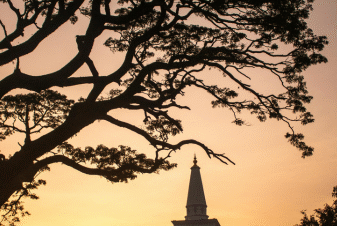
Constructed by King Nissanka Malla, the Rankoth Vehera is the largest stupa in Polonnaruwa, standing 54 meters tall. Modeled after the stupas of Anuradhapura, it symbolizes the continuation of Buddhist tradition and religious devotion.
Thuparama: A unique image house still with its original roof intact, housing a large seated Buddha statue.
Lankatilaka Vihara: A majestic image house with towering brick walls and a colossal standing Buddha statue, though the head is now missing.
These structures exemplify the fusion of architecture and sculpture in religious devotion.
Reflecting the Chola influence, Polonnaruwa also features Hindu temples, particularly Shiva Devalayas, constructed during South Indian rule. These granite temples are among the oldest structures in Polonnaruwa and represent the religious diversity of the time.
The Parakrama Samudra, or “Sea of Parakrama,” is an enormous man-made reservoir that spans over 2,500 hectares. Designed to irrigate vast tracts of farmland, it consists of five connected tanks. Its construction showcased advanced knowledge of hydraulic engineering and has continued to support agriculture for centuries.
One of the most remarkable features of Polonnaruwa was its religious harmony. During its golden age, it was home to not only Theravāda Buddhism but also Mahāyāna, Hinduism, and other Indian philosophical schools. Temples, monasteries, and shrines coexisted peacefully, and scholarly exchange flourished.
Polonnaruwa also became a renowned center for Buddhist education and scholarship, attracting monks and students from across Asia.
Polonnaruwa’s decline began after the death of King Parakramabahu I. Subsequent rulers lacked his vision and leadership, and the city gradually weakened due to internal strife and invasions.
By the late 13th century, repeated invasions by South Indian forces and changing political centers led to the abandonment of Polonnaruwa as a capital. The royal court eventually moved to Dambadeniya and other southern cities.
For centuries, the once-great city lay hidden beneath the jungle until rediscovered and excavated by British colonial archaeologists in the 19th and 20th centuries.
Today, Polonnaruwa is both a sacred pilgrimage site and a major tourist attraction. Visitors can explore its open-air museum of ruins by bike or foot, experiencing firsthand the grandeur and spiritual ambiance that defined ancient Sri Lanka.
In 1982, the Ancient City of Polonnaruwa was designated a UNESCO World Heritage Site for its cultural significance, architectural marvels, and historic value.
Polonnaruwa is a stunning testament to Sri Lanka’s resilience, creativity, and spiritual heritage. Its ruins whisper stories of visionary kings, tireless monks, and a civilization that embraced both faith and reason. Whether you are an archaeologist, a spiritual seeker, or a curious traveler, Polonnaruwa invites you to journey through time and marvel at the enduring legacy of an ancient kingdom.